In this article:
-
The Hidden Triggers: From "sensitive" wipes to the food on their plate.
-
The Solution: Key factors to look for when choosing the right eczema cream.
Before you spend another dime on a "miracle" lotion, read this.
Even the best cream in the world can't fix eczema if you are ignoring the hidden triggers.

The Search for a Cure: My Personal Experience
I know exactly what your bathroom counter looks like right now.
It’s likely a graveyard of half-used tubes, jars, and bottles of creams that promised to fix everything, but didn't. I know, because that used to be my counter.
When I was battling eczema at a young age, I didn't just try the drugstore brands. I was the person willing to try anything to make the itching stop. I went to a specialized Korean Han Clinic to take traditional herbal medicine. I even started gardening -growing my own Aloe Vera plants just so I could slice open the fresh leaves and apply the raw gel directly to my inflamed skin.
I was genuinely trying so hard. I thought if I just found the one magical ingredient-right herb, the right plant, the right expensive lotion- it would cure me. But I was looking for a magic wand when what I needed was a system. I realized I was approaching the problem backward. I was obsessively trying to put out the fire with lotions, but I wasn't looking for the person holding the matches.
Here is the truth: Eczema skin needs cream.
It is thirsty and damaged. But if you are applying cream while ignoring the environmental triggers, you are fighting a losing battle.
3 most common triggers parents overlook.
Trigger #1: Hidden Chemical Irritants (Wipes & Laundry)
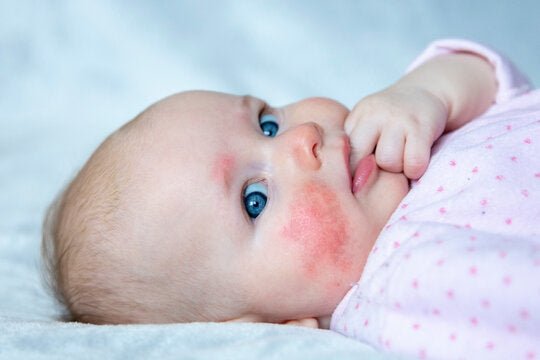
Babies with a compromised skin barrier have hyper-sensitive immune systems. Things that smell "fresh" or claim to be "clean" are often chemical warfare to their skin.
The "Wet Tissue" Trap This is the most common mistake. Even wipes labeled "sensitive" or "unscented" often contain preservatives to stop mold from growing in the wet package.
-
The Culprit: A common preservative is Methylisothiazolinone (MI). Studies cited in Occupational Dermatology have identified MI as a significant cause of allergic contact dermatitis, noting that it can worsen rashes even in products designed for babies.
-
The Fix: Stop using wipes for pee diapers. Use the "French Method": a cotton ball or soft dry cloth dipped in lukewarm water.
The Laundry Detergent Issue Detergents with fragrances leave a residue on clothes that sits against your baby's skin 24/7.
-
The Culprit: Optical brighteners and synthetic fragrances found in standard detergents and fabric softeners.
-
The Fix: Switch to a "Free & Clear" detergent and never use fabric softener or dryer sheets.
Trigger #2: Food Allergens (And Why Skin Comes First)
Many parents think food allergies cause the eczema. But groundbreaking research suggests it might be the other way around.
Scientists call this the "Dual Allergen Exposure Hypothesis." When a baby has a "leaky" skin barrier, food particles (like peanut dust or milk proteins) can enter the body through the skin cracks, triggering an immune response.
A study published in the Journal of Allergy and Clinical Immunology: In Practice found that treating eczema aggressively and early (fixing the skin barrier) actually resulted in fewer food allergies by age two.
-
The Takeaway: Don't just eliminate foods blindly. Focus on sealing the skin barrier to stop allergens from getting in.
-
The Strategy: If you suspect a specific food trigger (like cow's milk or eggs), consult your pediatrician before changing the diet.
Trigger #3: The Heat Factor
We often worry about babies getting cold and dry (especially during winter), so we bundle them up. But for an eczema baby, sweat is an itch-inducer.
When sweat dries on the skin, it leaves behind sodium, which can irritate the "leaky" skin barrier we discussed earlier. If your baby wakes up scratching, check if they are too hot.
-
The Fix: Keep the nursery cool (around 68-70°F or 20-21°C) and stick to 100% cotton clothing. Avoid wool and synthetic fabrics that trap heat.
The Solution: Choosing the Right Cream
Once you have removed the triggers, you have stopped the active attacks on your baby's skin. Now, your skincare can finally do its job.
But you can't just use a watery lotion. You need a cream that mimics the skin's natural "mortar"—rich in ceramides and lipids—to physically patch the holes in the wall. This isn't just about comfort; as the research shows, sealing the barrier is critical for overall health.
If you want a product that checks every single safety box without the guesswork, we recommend CHA&MOM Phyto Seline Intense Cream.

Developed by CHA Bio Group (CHA Hospital) -Korean experts with 60 years of research in mother and baby care- this isn't just a moisturizer, it's a barrier repair system.
Why it works when others fail:
-
🏥 Hospital-Grade Science: Formulated by medical researchers, not just a beauty lab.
-
🌿 Phyto Seline™ Complex: Mimics the "Probiotic Shower" babies receive at birth to naturally boost skin immunity.
-
💧 72-Hour Moisture: Clinical tests show it locks in hydration for 3 days.
-
🛡️ The "Smart Mortar": Packed with Phytoceramides and Jojoba Oil to physically fill the gaps in the skin barrier.
[Stop the Itch: Get CHA&MOM Phyto Seline Cream Here]
You Are Doing a Great Job
Before you go, I want to say one thing: Eczema is exhausting. It plays games with your mind and makes you feel like you aren't doing enough. You are doing enough.
Don't let a bad skin day make you feel like a bad parent. Take a deep breath, check the triggers, apply the cream, and give yourself some grace. You’ve got this.
Key Takeaways
-
Skincare is vital, but the environment comes first: Even the best cream can't fight constant irritation from wipes, detergents, or allergens.
-
Beware of "Clean" Chemicals: Ditch the wet wipes (use water/cotton) and skip fabric softeners.
-
Seal the Barrier: Fixing the skin early doesn't just stop the itch—it may help prevent food allergies later.
-
Trust Medical Research: Look for barrier-repairing creams backed by science, to truly fix the "leaky" skin wall.
📍Medical Disclaimer: I am not a doctor. The information in this post is for educational purposes only and based on research and personal experience. Always consult with your pediatrician or a pediatric dermatologist before making changes to your baby's treatment plan.
Sources:
- Journal of Allergy and Clinical Immunology: In Practice: "Earlier aggressive treatment to shorten the duration of eczema in infants resulted in fewer food allergies at 2 years of age"
-
Clinical & Experimental Allergy: "Management of infant atopic eczema to prevent severe eczema and food allergy"
-
Eczema in Early Life: Genetics, the Skin Barrier, and Lessons Learned from Birth Cohort Studies. Biagini Myers, Jocelyn M. et al. The Journal of Pediatrics, Volume 157, Issue 5, 704 - 714